
Juan García Faces Rival Crowd Taunts That Reveal a Deeper Cultural Divide
Authored by freebet.dev, 15 Apr 2026
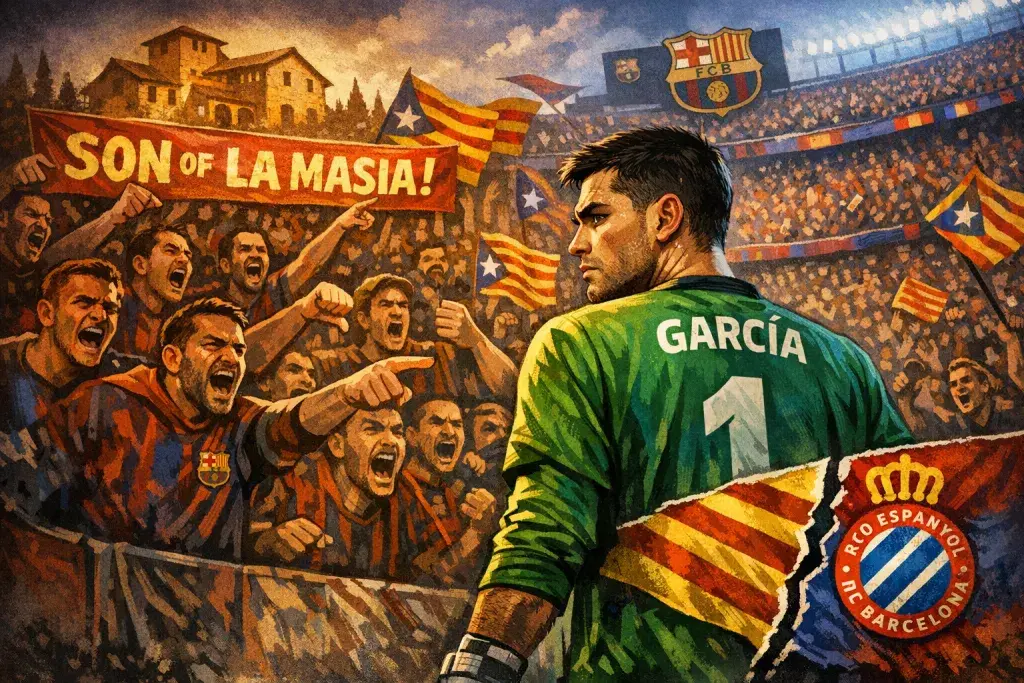
When Espanyol's 24-year-old goalkeeper Juan García took his position at Spotify Camp Nou on Saturday, the reception he received from the home crowd was neither silence nor simple hostility — it was something more pointed. Barcelona supporters greeted him with sarcastic chants of "Juan García, son of La Masia," a phrase that weaponises the history of Barcelona's renowned youth academy to mark him as an outsider who belongs, in some symbolic sense, to the wrong side. The moment captured something that extends well beyond one afternoon's friction: the way identity, belonging, and institutional loyalty are negotiated — loudly and publicly — in the world of Catalan civic culture.
The Meaning Behind the Chant
La Masia, Barcelona's youth development facility, carries an almost mythological weight in Catalan cultural consciousness. It is not merely a training ground; it functions as a symbol of a particular philosophy — the idea that a certain kind of person, shaped by a certain kind of place, represents something authentic and locally rooted. To call García a "son of La Masia" sarcastically is to deploy that mythology as exclusion rather than welcome. It says: you are not one of us, and we will remind you of it publicly.
The chant is not new. It had already circulated in previous encounters and was audible during García's international debut with the Spain national side against Egypt last March, where he was booed despite representing the country rather than either club. That moment was telling. The hostility had detached itself from club rivalry and followed him into a neutral context, suggesting the crowd's feeling was less about football loyalty and more about a perceived cultural or institutional allegiance.
García also heard sustained boos at Espanyol's own ground during the first leg of this fixture — an unusual inversion where a home crowd's behaviour toward a visiting figure echoed across the subsequent encounter. The repetition across different venues and contexts gives the chant a persistence that elevates it from crowd noise into something worth examining carefully.
Crowd Behaviour as a Form of Cultural Commentary
Mass crowd behaviour in high-tension civic gatherings has long been studied as a form of collective expression. Chants, especially satirical ones, function as compressed social commentary — they require shared knowledge, a recognisable target, and a punchline that lands only if the audience understands the reference. The La Masia chant works precisely because everyone present knows what La Masia represents. It is culturally legible to an informed audience in a way that a generic insult would not be.
This kind of targeted, ironic public address is not unique to Catalonia. In politically and culturally charged urban environments across Europe, sporting gatherings have long served as one of the few remaining public spaces where large groups of people express collective identity, grievance, and allegiance simultaneously. The chant directed at García fits a wider pattern in which individuals become symbolic proxies for institutional or regional tensions that exist far beyond any single individual's actions or choices.
What makes García's case particularly layered is that the target is not a rival official, a controversial figure, or someone who made a public statement inviting scrutiny. He is a young goalkeeper doing his professional work. The crowd's focus on him reflects less on his conduct than on the anxieties and identities the crowd itself is negotiating through the act of collective vocalisation.
García's Professional Standing Amid the Noise
Set against the cultural theatre surrounding him, García's record in La Liga this season is quietly exceptional. Having conceded only 19 goals across 24 appearances while making 64 crucial interventions, he is on course for the Zamora Award — the distinction given annually to the goalkeeper with the best goals-conceded ratio in the division. It is one of the most respected individual honours in Spanish football.
On Saturday he conceded to Paul Lozano, a goal he could not prevent. But one concession does not meaningfully alter the statistical trajectory that has placed him among the most effective goalkeepers in the division this season. The contrast between his public reception — taunts, boos, sarcastic chants — and his professional performance creates a sharp irony. The crowd's narrative about him and his actual record exist in almost entirely separate registers.
That gap between perception and performance is itself a familiar dynamic in high-visibility professional environments. Public figures, whether in politics, culture, or professional fields that draw large audiences, frequently find that their symbolic role in a crowd's imagination diverges substantially from the reality of their work. García has become, at 24, an inadvertent emblem of Catalan rivalry — not because of anything he has said or done, but because of where he stands and who he works for.
What Endures After the Noise Fades
The chants at Spotify Camp Nou will not define García's career, but they offer a useful window into how public identity is assigned and contested in densely symbolic cultural spaces. La Masia is an idea as much as a place, and the crowd that invoked it on Saturday was not really talking about youth academies. It was asserting a boundary — marking who is inside and who is permanently outside, regardless of geography or merit.
That impulse, expressed through irony and collective repetition, is neither new nor limited to one city. But it is worth registering clearly for what it is: the use of cultural heritage as a tool of exclusion, directed at a young professional whose primary distinction, at this moment in his career, is that he is very good at his job.