
Arsenal Face a Defining Crossroads as Arteta's Position Comes Under Scrutiny
Authored by freebet.dev, 15 Apr 2026
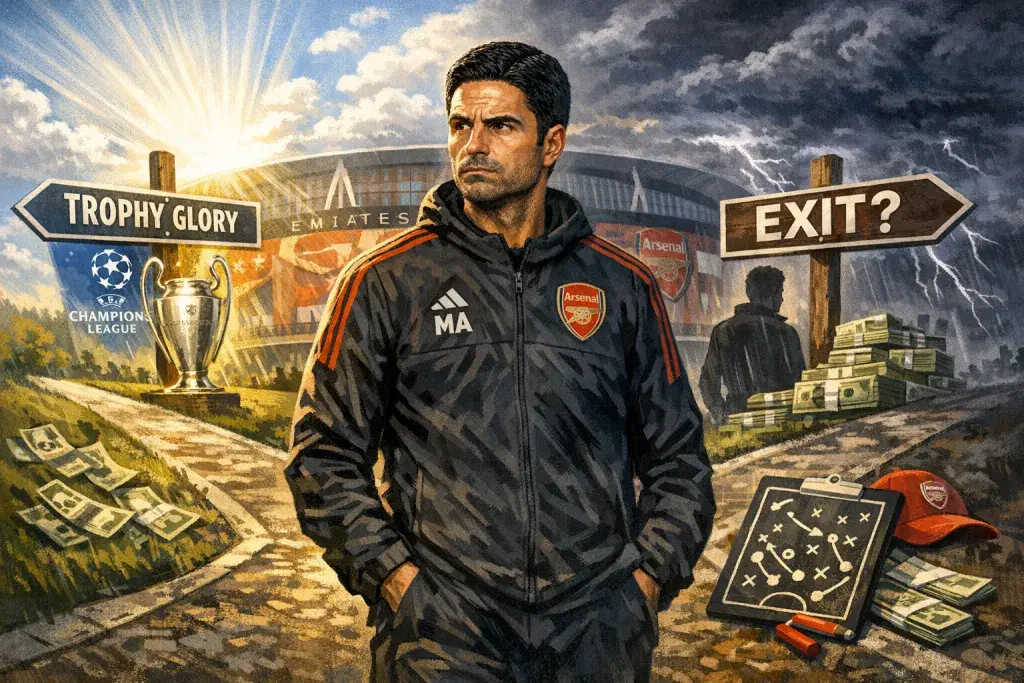
Pressure is intensifying around Mikel Arteta at Arsenal following a damaging home defeat to Bournemouth in the 32nd round of the Premier League, a result that has sharpened internal questions about the club's direction after several years of heavy financial investment without a major trophy to show for it. Spanish outlet Mundo Deportivo reports that Arteta's future at the club now depends almost entirely on whether Arsenal can end the current campaign with silverware. The board, according to the report, has a preferred successor already in mind.
A Trophy-or-Exit Ultimatum Taking Shape
Arsenal's hierarchy has reportedly grown restless. The club invested substantially in squad depth and quality over successive transfer windows, driven by a clear ambition to end a prolonged period without a top-tier honour. That investment was predicated on results — and another barren campaign would, according to Mundo Deportivo, exhaust the board's patience with the current management arrangement.
Arteta has overseen a genuine transformation in culture and performance at the club since taking over in December 2019, and there is no suggestion his standing has collapsed entirely. Arsenal remain in contention on two fronts: they sit on 70 points from 32 Premier League appearances, and they recently secured an important away result against Sporting Lisbon in the first leg of the Champions League quarter-finals. Neither run is over. But in high-stakes environments, proximity to success is rarely enough to insulate a manager from consequences — what matters is conversion.
The Bournemouth defeat also carried indirect consequences for the title picture. Manchester City, sitting second on 61 points from 30 outings, received an opening to narrow the gap at the top, injecting fresh uncertainty into a race that had appeared to be moving toward a settled conclusion.
Fàbregas as the Favoured Alternative
The name the Mundo Deportivo report puts forward as the board's "ready-made alternative" is Cesc Fàbregas — currently guiding Como in Serie B with a distinctly attack-minded philosophy that has the newly promoted club pushing for European qualification. That profile, according to the report, has already drawn interest from Arsenal officials.
Fàbregas spent eight seasons as a central figure at Arsenal before moving to Barcelona in 2011, which gives him both an institutional familiarity with the club and an emotional resonance with its identity. His playing career in north London began when he was just 16, and he went on to become one of the most celebrated midfielders of his generation, winning the FIFA World Cup and two European Championships with Spain. That biography, combined with an early coaching record that has impressed observers, positions him as a credible rather than sentimental choice — though it is worth distinguishing between a candidate drawing attention and a formal appointment being imminent.
Como's rise under Fàbregas has been notable for the clarity of its identity: possession-oriented, vertically ambitious, and built around young and technically capable personnel. Whether that approach would translate to the specific demands and expectations of a club of Arsenal's scale is a legitimate question — but it is the kind of question that tends to follow any managerial transition at elite level, regardless of the candidate involved.
What the Broader Pattern Reveals
Arsenal's situation reflects a wider tension that has become increasingly visible across European football's upper tier: the growing impatience of ownership groups who have deployed capital at scale and are now recalibrating expectations accordingly. The willingness to consider a change — even while the current manager remains competitive — signals that results are being evaluated not only in isolation but against a longer arc of accumulation. How many near-misses constitute proof of progress, and at what point do they become evidence of a ceiling?
Arteta has not been sacked. He has not been publicly undermined. But the emergence of named successors in credible publications, combined with internal pressure that Mundo Deportivo describes as real and mounting, creates a context in which every remaining fixture carries compounded weight. The coming weeks — in both the Premier League and the Champions League — will likely determine not just whether Arsenal win something, but whether Arteta remains the person entrusted to build on whatever comes next.